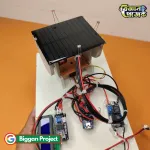
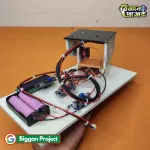
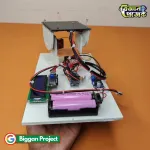
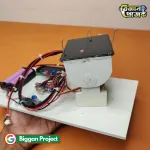
Smart Dual Axis Solar Tracker System with Arduino Nano and LCD Voltage Monitor
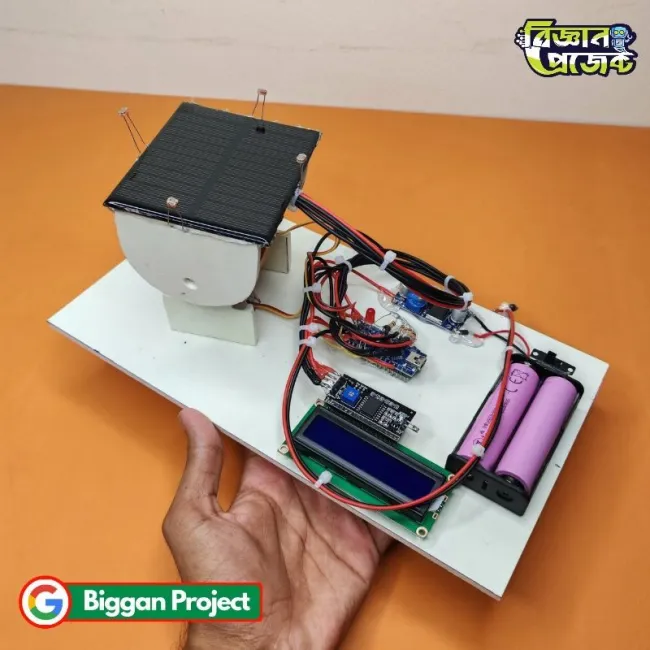
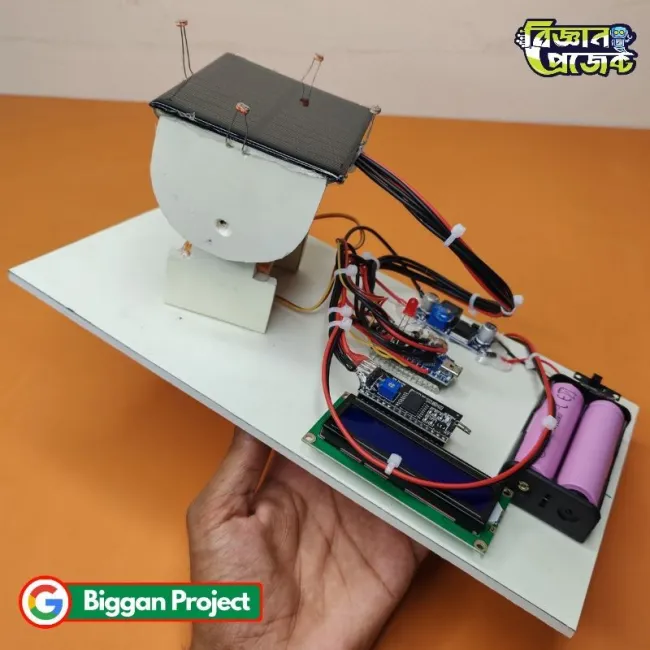
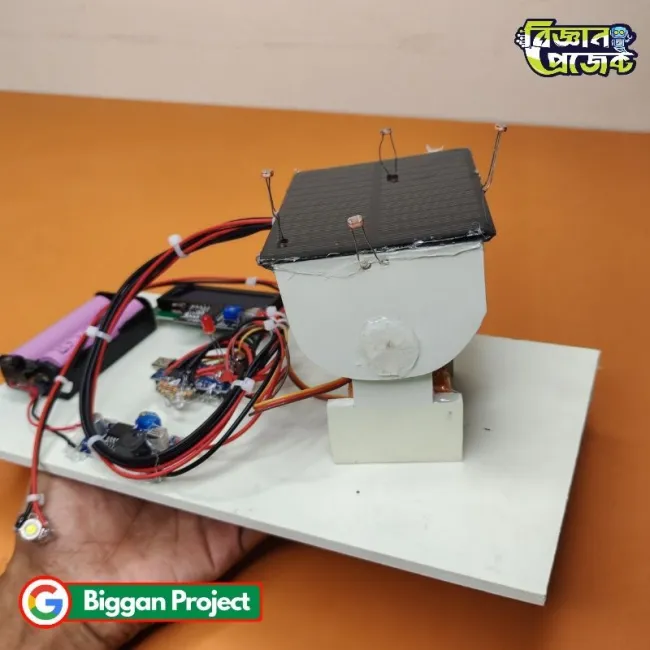
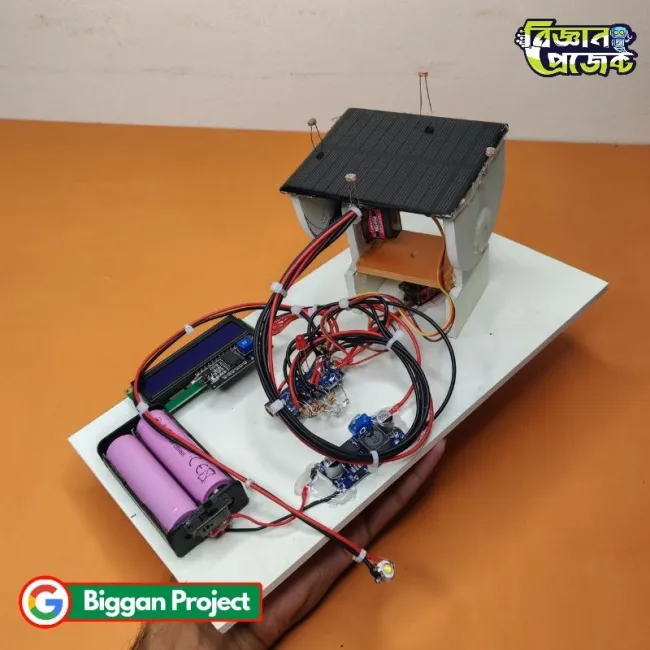
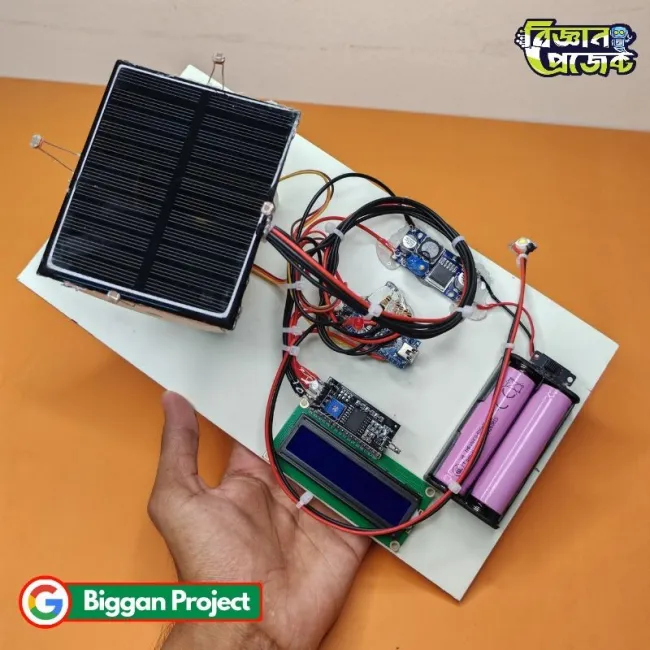
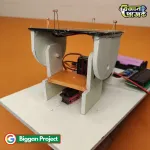
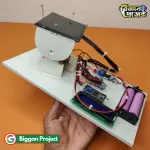
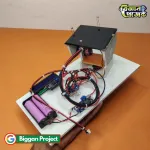
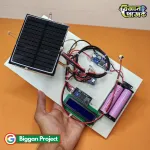
The Smart Dual Axis Solar Tracker System is an advanced, fully functional educational model engineered specifically for school, college, and university students in Bangladesh looking to excel in science competitions and Biggan Project exhibitions. Traditional static solar panels lose substantial energy potential because they remain fixed while the sun moves across the sky. This dual-axis tracking system overcomes that limitation by dynamically rotating both horizontally (azimuth) and vertically (elevation) to stay aligned with the strongest light source at all times. Built using accessible, industry-standard components—including an Arduino Nano V3.0 microcontroller, four sensitive 5mm LDR sensors, and dual MG90S metal gear servo motors—it provides a clear, practical demonstration of automated renewable energy harvesting. Whether presented at a local BD science fair or utilized in a STEM robotics workshop, this project bridges theoretical electronics with real-world green technology.
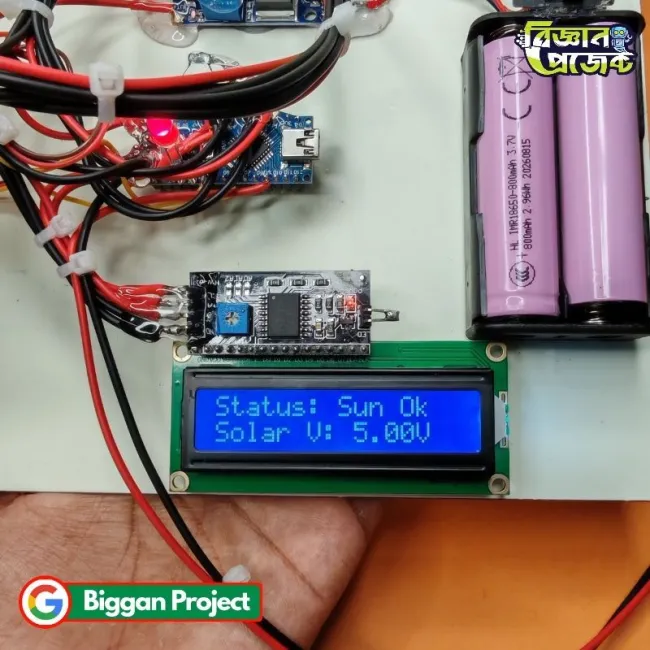
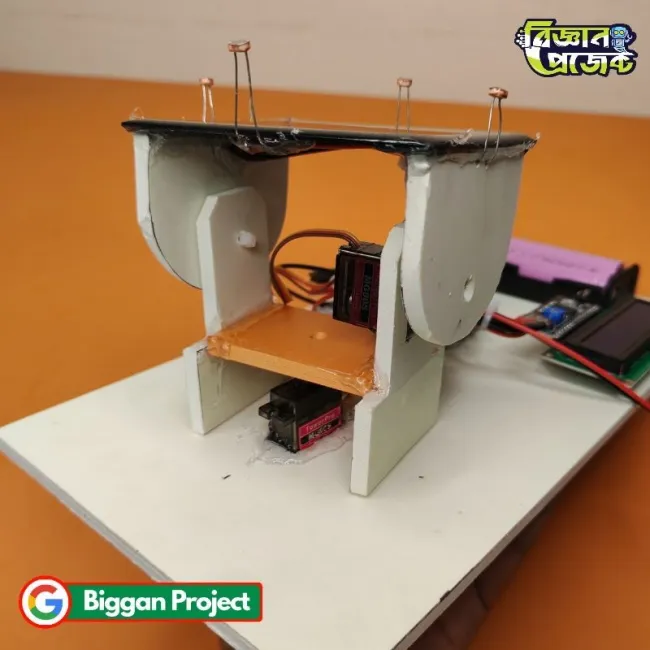
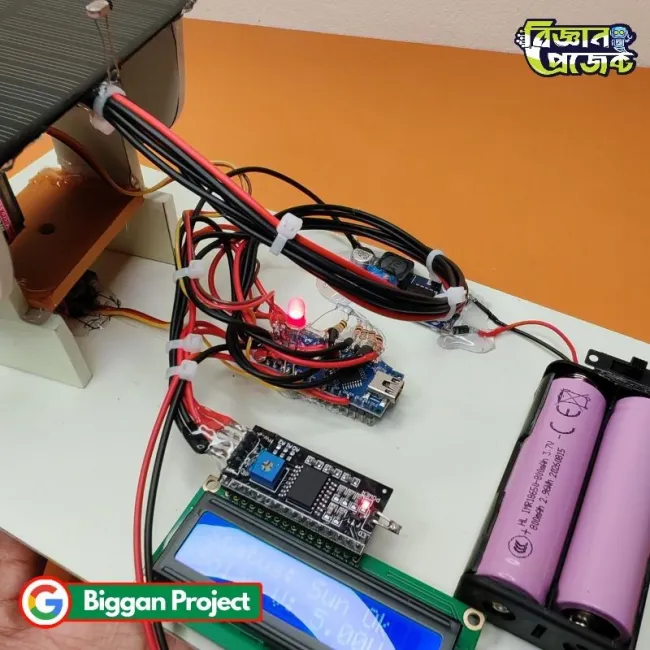
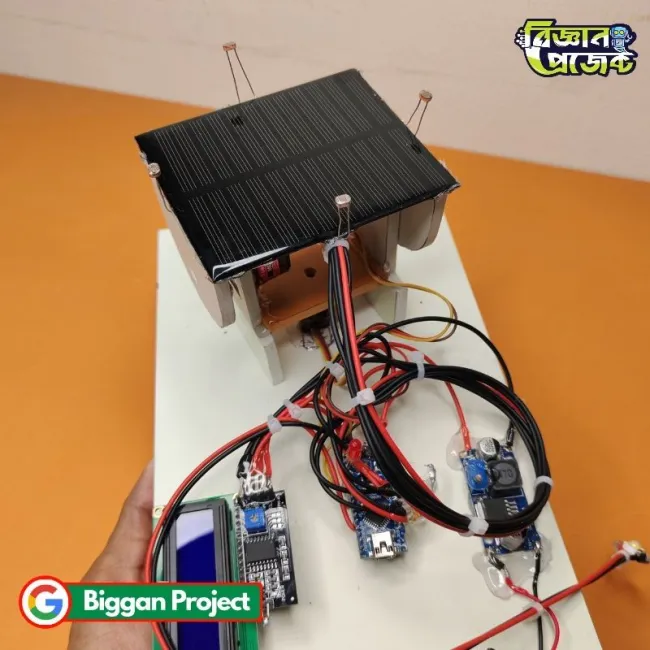
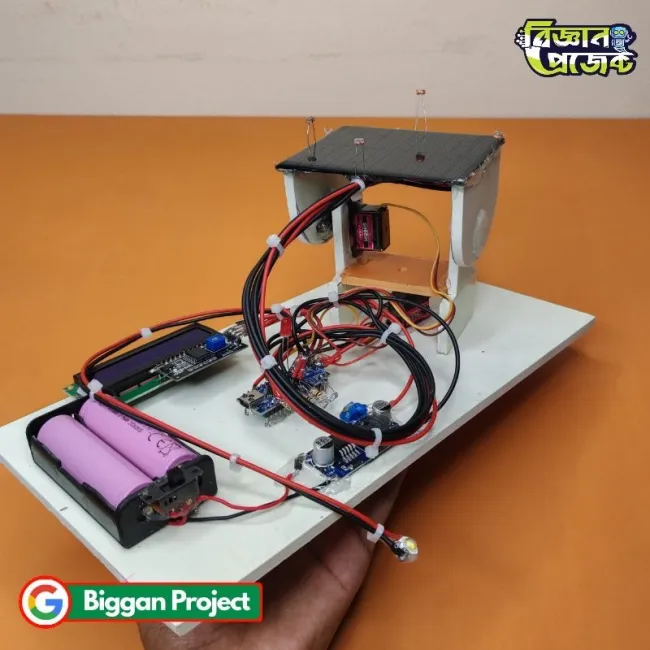
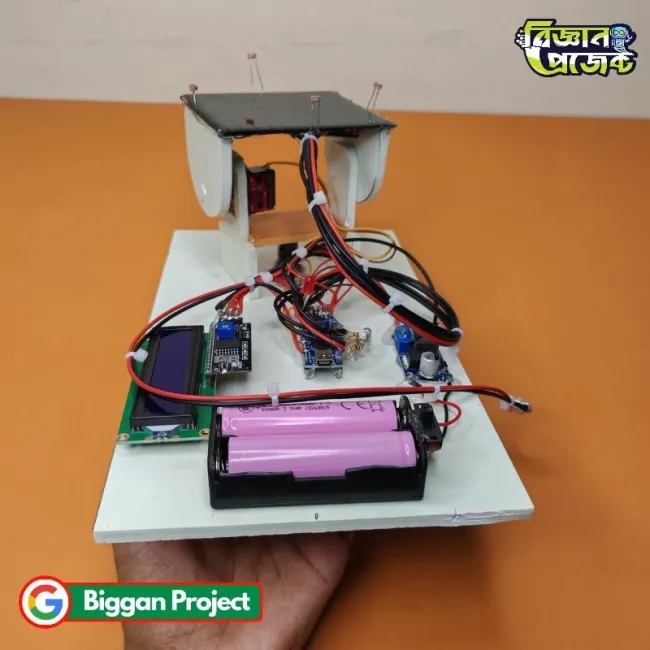
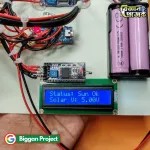
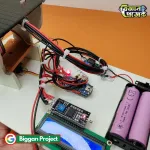
The mechanism operates through comparative analog sensing. Four LDR sensors arranged on the four edges of the solar assembly constantly evaluate incoming light intensity. When a mobile torch or focused light source shifts toward any side, the Arduino Nano calculates the differential values between top-bottom and left-right sensor pairs. The controller then signals the MG90S servo motors to reposition the 5V 0.75W solar panel until light distribution is completely balanced. Real-time electrical generation is tracked instantly on a pre-soldered 16x2 I2C LCD screen, allowing students and judges to observe how tracking directly influences power yield. The entire system is mounted on a rigid 5mm PVC chassis and powered by two rechargeable 18650 Li-ion cells stepped down via an LM2596 buck regulator, delivering a dependable, self-contained demonstration unit for any classroom or exhibition hall across Bangladesh.
| Specification |
Details |
| Product Category |
Dual Axis Solar Tracking Science Project DIY Kit |
| Main Controller |
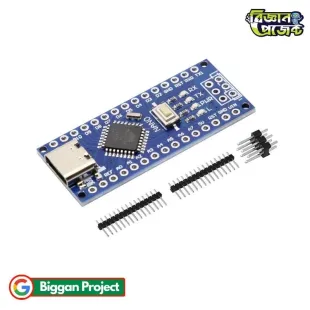
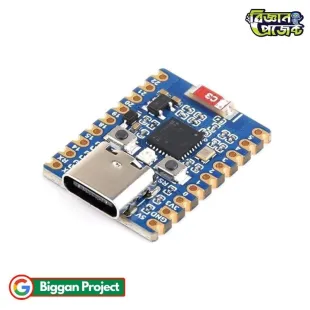
Arduino Nano V3.0 (Type-C USB interface, ATmega328P) |
| Tracking Degrees of Freedom |
Dual Axis (Horizontal / Azimuth and Vertical / Elevation) |
| Light Detection Sensors |
4x 5mm Light Dependent Resistors (LDR) |
| Actuators / Motors |
2x MG90S Metal Gear Micro Servos (180-degree sweep) |
| Solar Photovoltaic Panel |
5V 0.75W Polycrystalline Panel (Dimensions: 99 x 69 mm) |
| Display Module |
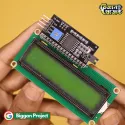
16x2 Character LCD with Pre-Soldered PCF8574 I2C Backpack |
| System Power Source |
2x 18650 3.7V Rechargeable Li-Ion Batteries (Series setup: ~7.4V - 8.4V) |
| Battery Holder |
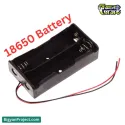
2-Chamber 18650 Battery Holder Case (Black) |
| Voltage Regulation |
LM2596 DC-DC Step-Down Buck Converter (Tuned to constant 5V output) |
| Output Load / Indicator |
1W High-Brightness Cool White COB LED Chip |
| Status Indication |
5mm Red LED (Battery charging status) |
| Main Power Switch |
6-Pin DPDT Slide Switch (Rated 50V 0.5A) |
| Frame and Mechanical Base |
5mm Rigid White Plastic PVC Board (1x1 Feet) |
| Wiring and Adhesion |
Slim Flexible Jumper Wires and 11x200mm High-Adhesion Hot Melt Glue |
Features
- Full two-axis tracking capability allowing 180-degree horizontal rotation and vertical tilt.
- Four-quadrant comparative light sensing utilizing high-sensitivity 5mm LDR units.
- Durable MG90S metal gear servo motors that prevent gear stripping during continuous movement.
- Integrated 16x2 LCD with I2C communication interface requiring only two microcontroller data pins (SDA/SCL).
- Real-time visual monitoring of generated solar voltage directly on the digital display.
- High-efficiency LM2596 switching regulator ensuring a ripple-free 5V logic supply from dual Li-ion cells.
- Integrated 1W COB LED demonstrating immediate, usable power output from the harvested energy circuit.
- Type-C Arduino Nano board enabling straightforward reprogramming, debugging, and code updates.
- Sturdy 5mm PVC structure engineered for portability, project stability, and exhibition durability.
Applications / Use Cases
- Primary and secondary school science fairs and National Biggan Project exhibitions across Bangladesh.
- Undergraduate engineering laboratory demonstrations for renewable energy, robotics, and embedded systems.
- STEM learning centers and DIY electronics workshops teaching automated sensor feedback loops.
- Interactive classroom visual aid explaining solar geometry and solar energy optimization.
- Foundation prototype for hobbyists developing agricultural or environmental monitoring equipment.
User Guide / How to Use
- Inspect the 2-chamber battery holder to ensure two fully charged 18650 Li-ion cells are inserted with correct polarity.
- Place the tracker on a flat, stable surface indoors away from direct, harsh sunlight to avoid sensor saturation.
- Slide the 6-pin DPDT switch to the ON position; verify the Arduino Nano power LED and 16x2 LCD screen illuminate.
- Check the 16x2 LCD display to confirm baseline voltage readings appear clearly on the screen.
- Take a mobile phone flashlight or torch and aim it toward the top LDR sensor to observe the vertical servo tilt upward.
- Move the light beam toward the bottom, left, and right sensors sequentially to verify smooth tracking along both axes.
- Direct the light squarely at the 5V solar panel to observe the live voltage increase on the LCD and activate the 1W COB LED output.
- Slide the switch to the OFF position after demonstration to prevent battery depletion during storage.
Frequently Asked Questions (FAQs)
- Q: Why does the system fail to track properly in direct outdoor sunlight?
A: Direct sunlight floods all four LDR sensors simultaneously with maximum ambient light, eliminating the differential brightness readings required by the algorithm; it is calibrated specifically for directional indoor light like a mobile torch.
- Q: How do the dual MG90S servo motors divide their motion?
A: One servo controls the horizontal base rotation (azimuth left-to-right), while the second servo controls the vertical tilt mechanism (elevation up-and-down).
- Q: Can the Arduino Nano code be modified or updated by the student?
A: Yes, the onboard Type-C port connects directly to any computer running the Arduino IDE for adjusting sensitivity thresholds, servo sweep speeds, or display layouts.
- Q: What is the purpose of the LM2596 buck converter module in this setup?
A: Two series 18650 batteries deliver 7.4V to 8.4V, which exceeds safe operating limits for servos and microcontroller logic; the LM2596 steps this down cleanly to a regulated 5V.
- Q: What information is shown on the 16x2 LCD screen?
A: The display presents real-time voltage data generated by the 5V 0.75W solar panel, confirming efficiency gains when aligned directly with the light beam.
- Q: How is the red 5mm LED used in the circuit?
A: The red LED acts as an optical status indicator confirming battery connection and charge readiness.
Challenges and Considerations
- Sensor calibration requires uniform ambient indoor lighting to prevent unintended servo jitter.
- Direct outdoor sunlight will overwhelm ambient resistance ranges on standard LDRs without external optical dividers.
- Mechanical balance must be maintained so wire tension does not restrict servo sweep angles during continuous travel.
- Hot melt glue mountings should be kept away from high-heat environments to ensure long-term structural integrity.
Compatibility
- Microcontroller logic fully compatible with Arduino IDE (C/C++), AVR-GCC, and visual block programming tools.
- I2C LCD bus compatible with standard LiquidCrystal_I2C libraries operating on default addresses (0x27 or 0x3F).
- Servo control system compatible with standard 50Hz PWM signals from any Arduino, ESP32, or STM32 board.
- Power rail compatible with any regulated 5V DC source, USB power bank, or multi-cell Li-ion pack via buck converter.
Future Enhancement Options
- Integrating an MPPT (Maximum Power Point Tracking) charge controller circuit to optimize battery replenishment.
- Adding ambient light shading baffles or 3D-printed collimator tubes over LDR sensors for outdoor sunlight functionality.
- Incorporating an INA219 current/power sensor module to display wattage and milliampere draw alongside voltage on the LCD.
- Adding an ESP8266 or ESP32 Wi-Fi module for remote IoT energy logging and mobile dashboard tracking.
- Upgrading to a real-time clock (RTC DS3231) module to combine sensor tracking with mathematical astronomical solar positioning.
Benefits
- Demonstrates up to 30-40% theoretical efficiency gains over fixed solar panel arrays through hands-on practice.
- Provides an all-in-one, ready-to-demonstrate kit eliminating the need for complex custom fabrication from scratch.
- Teaches vital fundamentals of analog-to-digital conversion, servo PWM actuation, and I2C serial communication.
- Compact, self-powered design allows convenient transportation to school competitions and fairs across BD.
- Clear, transparent electronic architecture makes it easy for academic evaluators and science judges to inspect every stage.
Conclusion
The Smart Dual Axis Solar Tracker System is an exceptional practical tool that transforms complex automation, electronic sensing, and renewable energy theory into an engaging visual reality. By combining dependable servo mechanics, precise micro-controller logic, and instant digital feedback via an I2C LCD screen, this model delivers tremendous educational value for aspiring innovators. It stands as an ideal choice for Bangladeshi students seeking an impactful, high-scoring project for local exhibitions and science fairs.
solar tracker, dual axis solar tracker, solar tracking project, arduino solar tracker, arduino dual axis solar tracker, solar tracker kit, solar tracking system, automatic solar tracker, dual axis tracker, solar tracker arduino nano, solar panel tracker, science project solar tracker, biggan project, biggan project solar, solar tracker bd, solar tracker bangladesh, solar project bd, diy solar tracker, dual axis solar kit, solar tracker ldr, servo solar tracker, mg90s solar tracker, solar tracker lcd, 2 axis solar tracker, dual axis sun tracker, automatic sun tracking, solar energy project, solar tracker robot, student science project, school science project, college science project, solar panel project, smart solar tracker, arduino sun tracker, tracker solar, dual axis solar, solar tracker arduino, solar project, solar tracker ldr servo, soler tracker, solar traker, soler traker, solar trackar, soler trackar, dual exis solar tracker, duel axis solar tracker, duel exis solar tracker, dual axies solar tracker, solar treker, soler treker, solar tarcker, soler tarcker, solar trakar, solar trekar, solar trakker, soler trakker, solar trackor, soler trackor, solar trackur, arduno solar tracker, ardueno solar tracker, arduyno solar tracker, arduno solar traker, arudino solar tracker, solar traking, solar traking project, solar tracking projec, solar traker bd, soler tracker bd, biggan project kit, biggan projec, bigan project, biggon project, solar tracker price bd, solar tracker project kit, sholar tracker, solar tarcker bd, ldr solar tracker, arduino nano solar tracker, 2 axis sun tracker, solar tracking system kit, arduino tracking solar, diy solar project, solar tracker science fair, science fair solar tracker, dual axis solar tracking system, automatic solar tracking kit


 Science Projects
 Sensor & Modules
 Basic Components
 Development Boards
 Robotic Parts
 Drone Parts
 Tools & Accessories
 Power Sources
 Kits & Combo
 IC & Microchip
 Cables & Connectors
 Audio Components