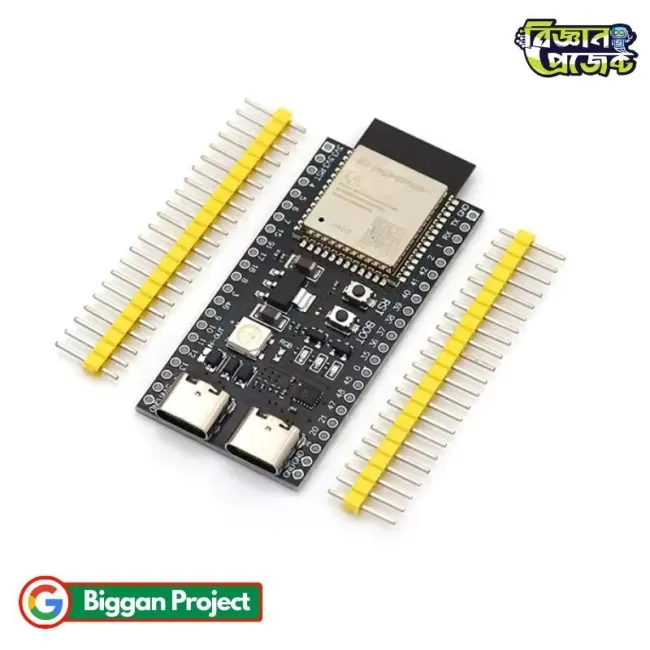
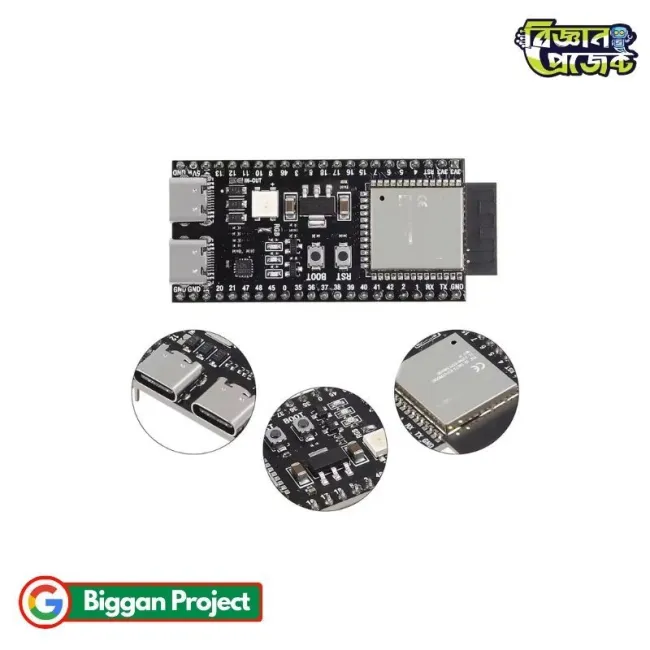
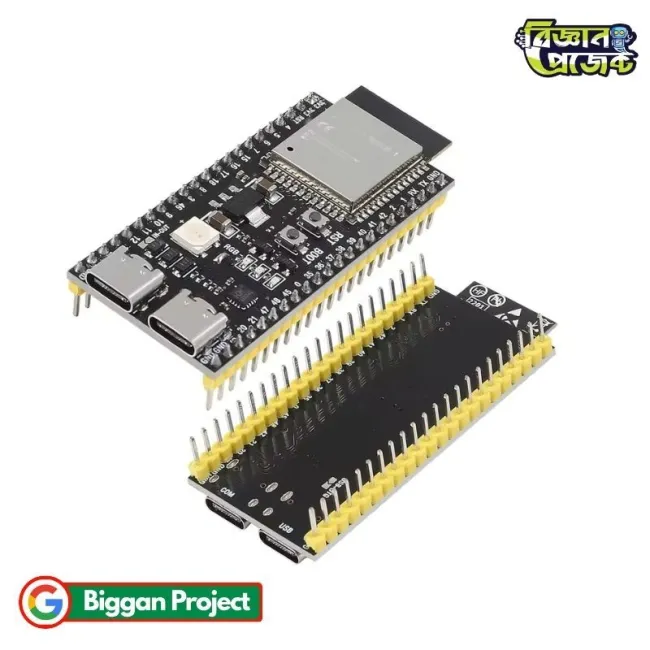
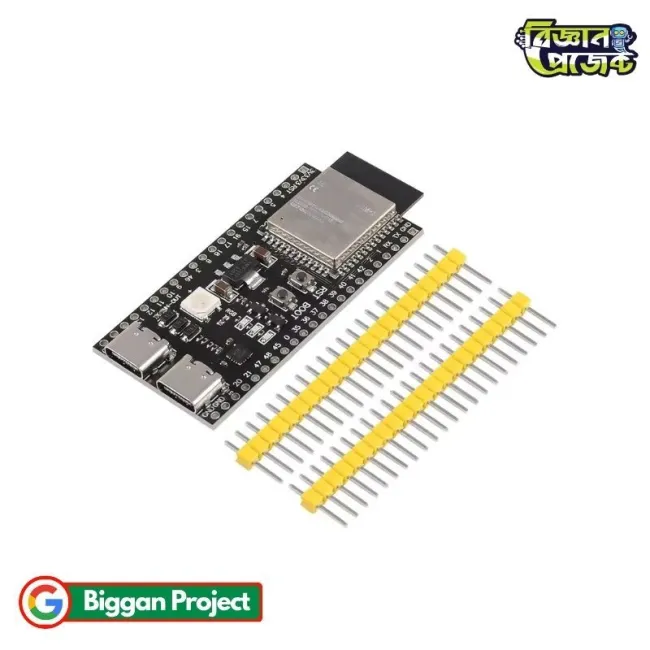
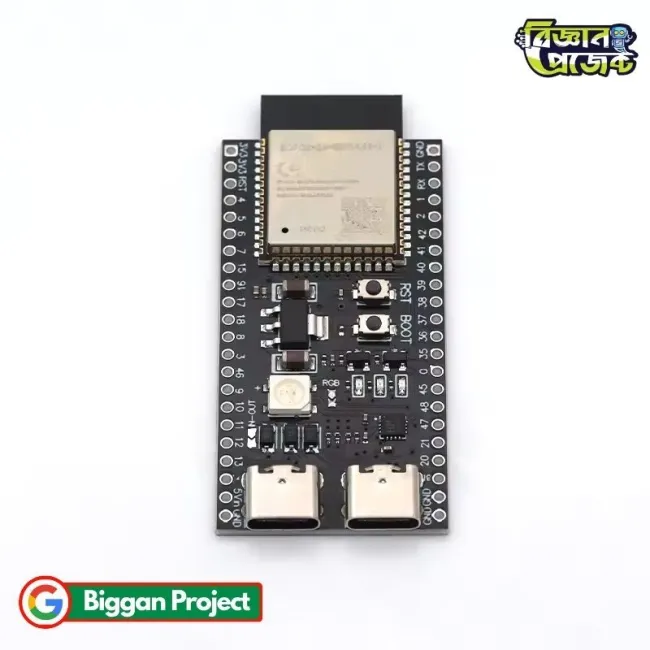
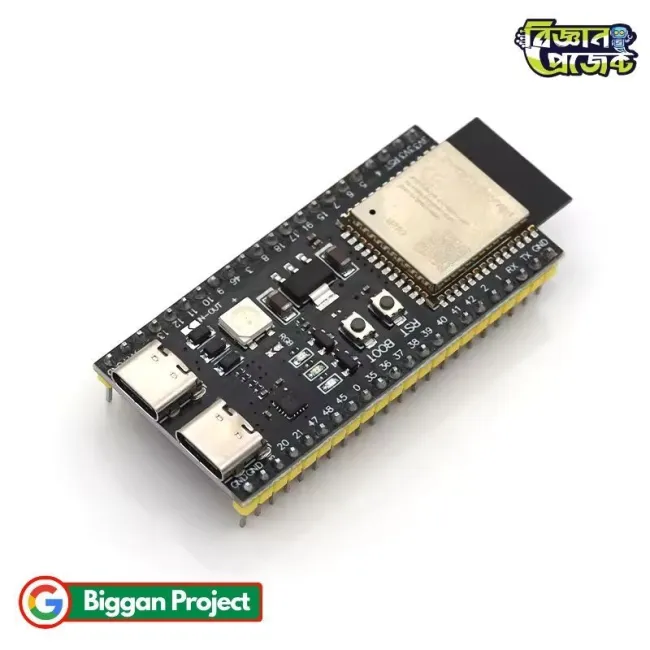
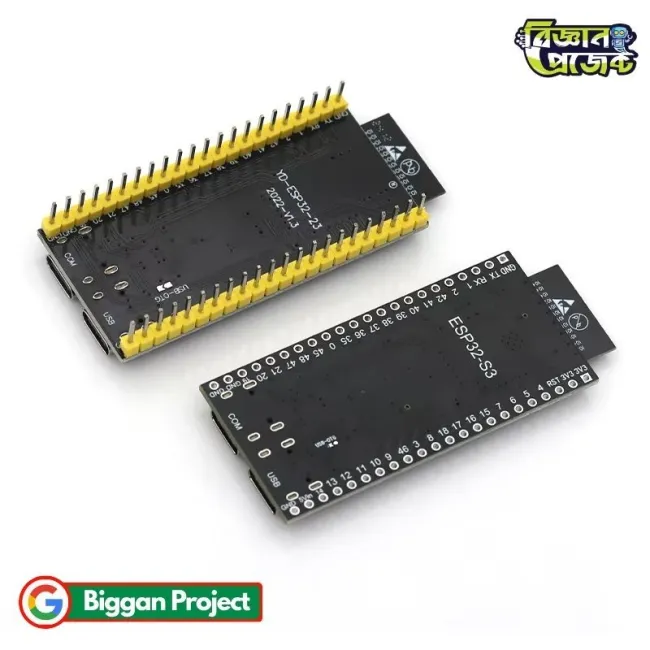
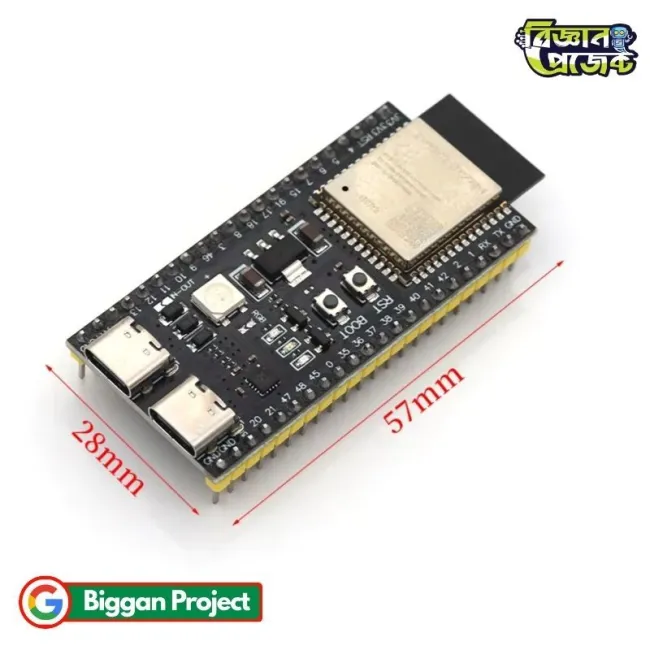
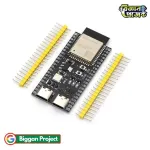
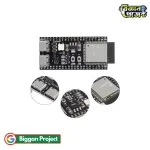
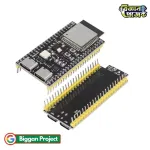
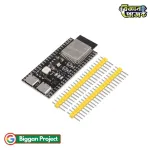
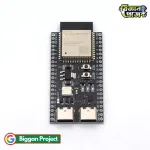
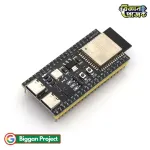
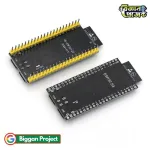
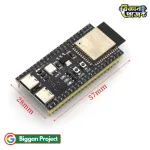
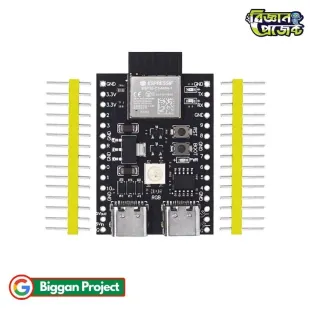
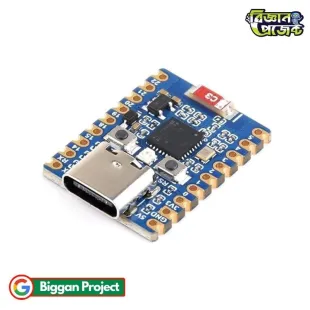
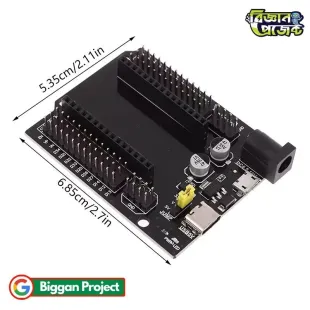
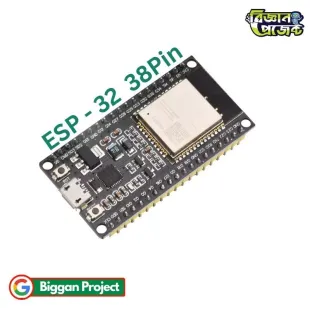
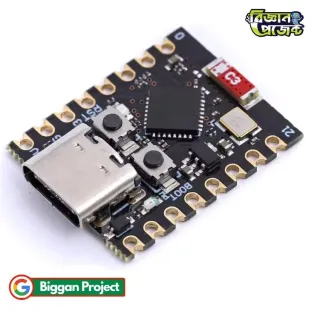
ESP32-S3-WROOM-1 DevBoard N16R8 Dual Type-C Microcontroller Module
The ESP32-S3-WROOM-1 DevBoard N16R8 is a high-performance development board powered by the Xtensa dual-core 32-bit LX7 processor running at clock speeds up to 240 MHz. Built for demanding embedded systems, Internet of Things (IoT) applications, and advanced robotics, this module integrates 2.4 GHz Wi-Fi and Bluetooth 5.0 (BLE Mesh) directly onto the SoC. Featuring 16MB Flash memory and 8MB Octal PSRAM, it provides ample capacity for running complex algorithms, graphic user interfaces, MicroPython applications, and local artificial intelligence vector processing. Tech enthusiasts, students, and DIY engineers across BD can leverage this versatile unit to build smart automation solutions. The dual Type-C USB interface simplifies programming and power delivery while exposing native USB OTG and USB Serial/JTAG functionality for direct debugging. For makers looking to source high-grade components for their next विज्ञान প্রজেক্ট (Biggan Project) in Bangladesh, this development platform offers exceptional reliability and performance.
Product Specifications
| Specification |
Details |
| Processor Core |
Xtensa 32-bit LX7 dual-core, up to 240 MHz |
| Flash Memory |
16MB Quad/Octal SPI Flash (N16) |
| PSRAM |
8MB Octal SPI PSRAM (R8) |
| SRAM / ROM |
512KB SRAM, 384KB ROM, 16KB RTC SRAM |
| Wireless Protocol |
2.4 GHz Wi-Fi (802.11 b/g/n, 150 Mbps), Bluetooth 5.0 LE / Mesh |
| USB Interface |
Dual USB Type-C (1x Native USB OTG, 1x USB Serial/JTAG) |
| GPIO Count |
Up to 45 programmable GPIO pins |
| Analog Peripherals |
2 x 12-bit SAR ADC (up to 20 channels), 14 x Capacitive Touch GPIOs |
| Digital Interfaces |
4x SPI, 3x UART, 2x I2C, 2x I2S, 1x DVP Camera, 1x LCD Interface (RGB/I8080/M6800) |
| Hardware Security |
AES, SHA, RSA, ECC, Secure Boot, Flash Encryption, Digital Signature, HMAC |
| Operating Voltage |
3.0 V to 3.6 V (5 V input via USB Type-C) |
| Operating Temperature |
-40 °C to +65 °C |
Key Features
- High-speed Xtensa dual-core LX7 processor running at 240 MHz for multitasking execution.
- Generous onboard memory configuration featuring 16MB Flash and 8MB PSRAM.
- Integrated dual-mode 2.4 GHz Wi-Fi and Bluetooth Low Energy 5.0 with Mesh support.
- Dual USB Type-C connectors allowing separate UART debugging and native USB OTG operations.
- Hardware acceleration support for vector processing and machine learning models.
- Comprehensive security suite with Flash Encryption, Secure Boot, and hardware cryptographic accelerators.
- Dedicated camera (DVP) and display interfaces suitable for vision and graphical projects.
Applications and Use Cases
- Autonomous robotics, gyro-controlled vehicles, and obstacle navigation systems.
- Smart home automation hubs, Wi-Fi environmental monitoring, and gas/fire detection systems.
- Artificial intelligence at the edge, including basic image recognition and voice processing.
- Wireless IoT sensors transmitting real-time data to cloud platforms.
- Educational electronics, engineering thesis implementations, and science competition projects in BD.
User Guide / How to Use
- Connect the board to your PC using a high-quality USB Type-C cable via the USB-to-UART port.
- Open the Arduino IDE, add the ESP32 board manager URL in preferences, and install the ESP32 platform package.
- Select "ESP32S3 Dev Module" as your board target in the tools menu.
- Configure the board settings: Set Flash Size to "16MB" and PSRAM to "OPI PSRAM".
- For MicroPython, flash the ESP32-S3 firmware binary using esptool before uploading scripts via Thonny IDE.
- Connect sensors, displays, or actuators to the breakout GPIO headers according to your schematic layout.
Frequently Asked Questions (FAQs)
- Q: What is the difference between N16R8 and other variants like N8R2?
A: N16R8 features 16MB Flash memory and 8MB PSRAM, whereas N8R2 features 8MB Flash memory and 2MB PSRAM.
- Q: Can this board be powered directly through the USB Type-C port?
A: Yes, it accepts a 5V power input via the Type-C port, which is stepped down to 3.3V onboard.
- Q: Is the ESP32-S3 backward compatible with code written for the standard ESP32?
A: Most core libraries are compatible, though pin definitions and specific peripheral registers need adjustment for the S3 architecture.
- Q: Does this board support MicroPython and Arduino IDE?
A: Yes, it fully supports Arduino IDE, MicroPython, CircuitPython, and Espressif's native ESP-IDF framework.
Challenges and Considerations
- Requires correct selection of PSRAM settings (OPI PSRAM) in the IDE for full memory usage.
- ADC pins may experience non-linear readings near upper and lower voltage limits requiring calibration.
- Simultaneous high-throughput Wi-Fi transmission and heavy PSRAM usage can increase current draw, requiring a stable power supply.
Compatibility
- Compatible with standard 2.54mm breadboards and jumper wires.
- Supports standard I2C, SPI, UART, and PWM sensors, modules, and displays.
- Fully compatible with Windows, macOS, and Linux development environments.
- Works with Arduino IDE, ESP-IDF, MicroPython, and PlatformIO.
Future Enhancement Options
- Adding an OV2640 or OV5640 camera module via the DVP interface for visual tracking.
- Integrating a SPI or parallel TFT display for real-time telemetry dashboards.
- Connecting external SD card storage via the built-in SDIO interface for datalogging.
- Attaching battery management units for portable outdoor IoT applications in Bangladesh.
Benefits
- High computational power handles both processing and communication tasks on a single board.
- Large PSRAM footprint enables smooth handling of video streams, web servers, and heavy codebases.
- Dual USB ports eliminate the need for external programmers or FTDI converters.
- Rich ecosystem of open-source libraries speeds up prototype development for any Biggan Project.
Conclusion
The ESP32-S3-DevKitC-1 N16R8 development board is a robust, versatile, and future-proof platform for embedded systems development. Combining dual-core high-speed processing, expansive storage, dual Type-C connectivity, and dual wireless modes, it serves as an ideal foundation for innovative hardware solutions, IoT systems, and advanced robotics projects across BD.
esp32 s3, esp32-s3, esp32s3, esp 32 s3, esp32 s3 devkitc 1, esp32-s3-devkitc-1, esp32s3 devkitc 1, esp32 s3 wroom 1, esp32-s3-wroom-1, esp32s3wroom1, n16r8, n16 r8, n16r8 board, n8r2, n8r8, esp32 s3 n16r8, esp32-s3 n16r8, esp32 s3 wifi bluetooth, esp32 micropython board, esp32 s3 type c, dual type c esp32, esp32 s3 module, esp32 s3 price in bd, esp32 s3 bangladesh, esp32 s3 bd, biggan project, bigganproject, biggan project esp32, science project esp32, iot board, iot microcontroller, esp32 s3 pinout, esp32 s3 arduino, esp32 s3 psram, 16mb flash 8mb psram, esp32 dev board, esp32 board price in bd, esp32 price in bangladesh, esp 32 micro controller, esp32s3 board, es32 s3, esp32s, esp323, esp-32-s3, esp32 s3 module bd, esps3, esp32 micro python, micro python board, esp32 wifi module, wifi bluetooth board, esp32s3 module, bigyan project, biggan projec, bigan project, biggon project, ispi32, eep32, eap32, esp32 s3 devkit, microcontroller board bd

 Science Projects
 Sensor & Modules
 Basic Components
 Development Boards
 Robotic Parts
 Drone Parts
 Tools & Accessories
 Power Sources
 Kits & Combo
 IC & Microchip
 Cables & Connectors
 Audio Components